A long line of Sunday mornings
Granger Brethren is a small Czech-Brethren congregation that founded a Texas denomination. We're still on the same corner.
How it started
Czech Protestant immigrants started arriving east of Granger around 1879 to farm. The first service was held in the Friendship school east of Granger by the Rev. Henry Juren of Fayetteville. Later the Rev. Bohumil Lacjak of Wesley led occasional services until he died in a tragic accident. After that the gatherings stopped for a time, and families worshipped at home with Bibles and hymnbooks they had brought from Europe.
On May 28, 1892 the Rev. Adolph Chlumsky of Brenham came to Granger to perform the wedding of Josef J. Mikulencak and Anna Zarsky. At the wedding he urged the people to organize a congregation. Josef Mikulencak, Sr. (the groom's father) and Pavel Machu took up the idea. On July 10, 1892 the first service was held in the Moravia School four miles southeast of Granger. The congregation was formally organized that day, and Chlumsky was elected pastor. He came in by train from Brenham, six times a year at first, and served the congregation for the next eighteen years.
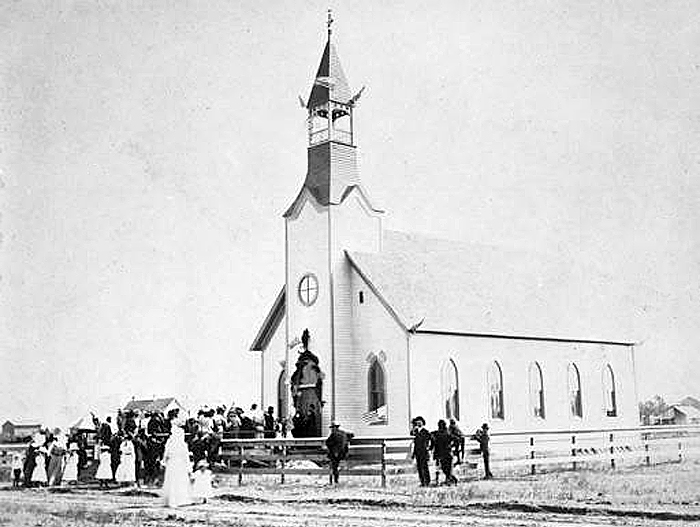
The members were eager to build a church. Their pastor advised against it for the moment, but they went ahead anyway: they pledged five hundred dollars on the spot, hauled boulders for the foundation from distant hills, and did all the labor themselves. The first building committee was J.F. Martinets, J.R. Machu, J.H. Wentrcek, Josef F. Wentrcek, John T. Machu, K. Martinets, and J.J. Mikulencak. The main structure was dedicated on September 22, 1901, completely paid for, with a new organ.
The denomination organized here
On December 29, 1903, twenty-two delegates from eleven Czech Brethren congregations across Texas met here, under Rev. Chlumsky's leadership, and organized the Evangelical Unity of the Czech-Moravian Brethren in North America. It's known today as the Texas Unity of the Brethren. The denomination is still active, with about twenty-eight congregations across the state. It began in this building.
Other things were organized in those years too. České Školy (Czech-language schools) organized in Granger in 1902. The Granger Brethren Christian Sisters group was founded in 1904 and stayed active for over a century. On July 6, 1910, Rev. Josef Barton, Sr. was ordained as our first resident pastor.
In 1914 the Hus School was formalized and its first class met in Granger.
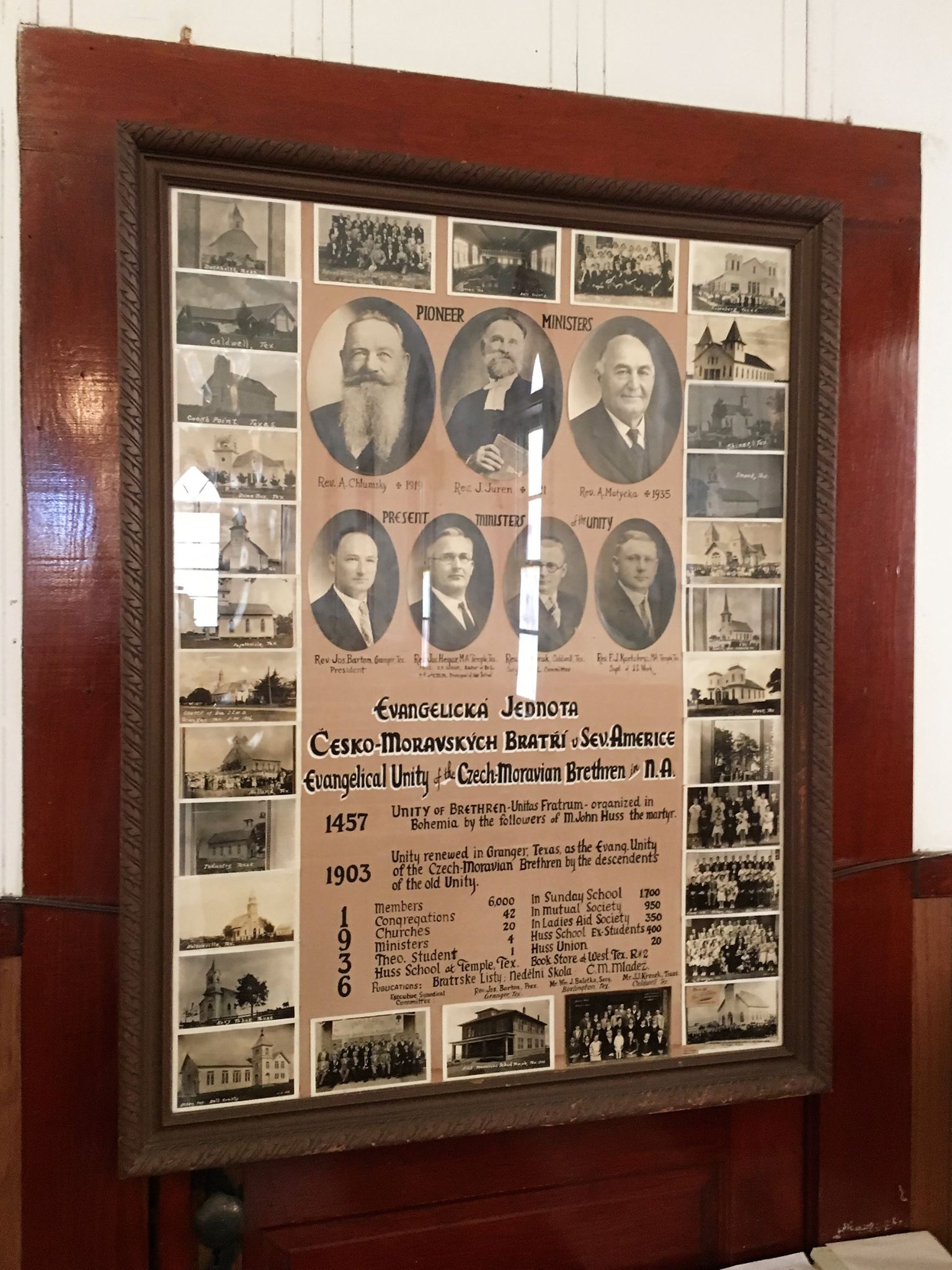
The Thirteenth Congress of the Unity of the Brethren met in Granger in July 1915. The convention program is preserved in the archive.
Eight days, $1,400, and a signed plank
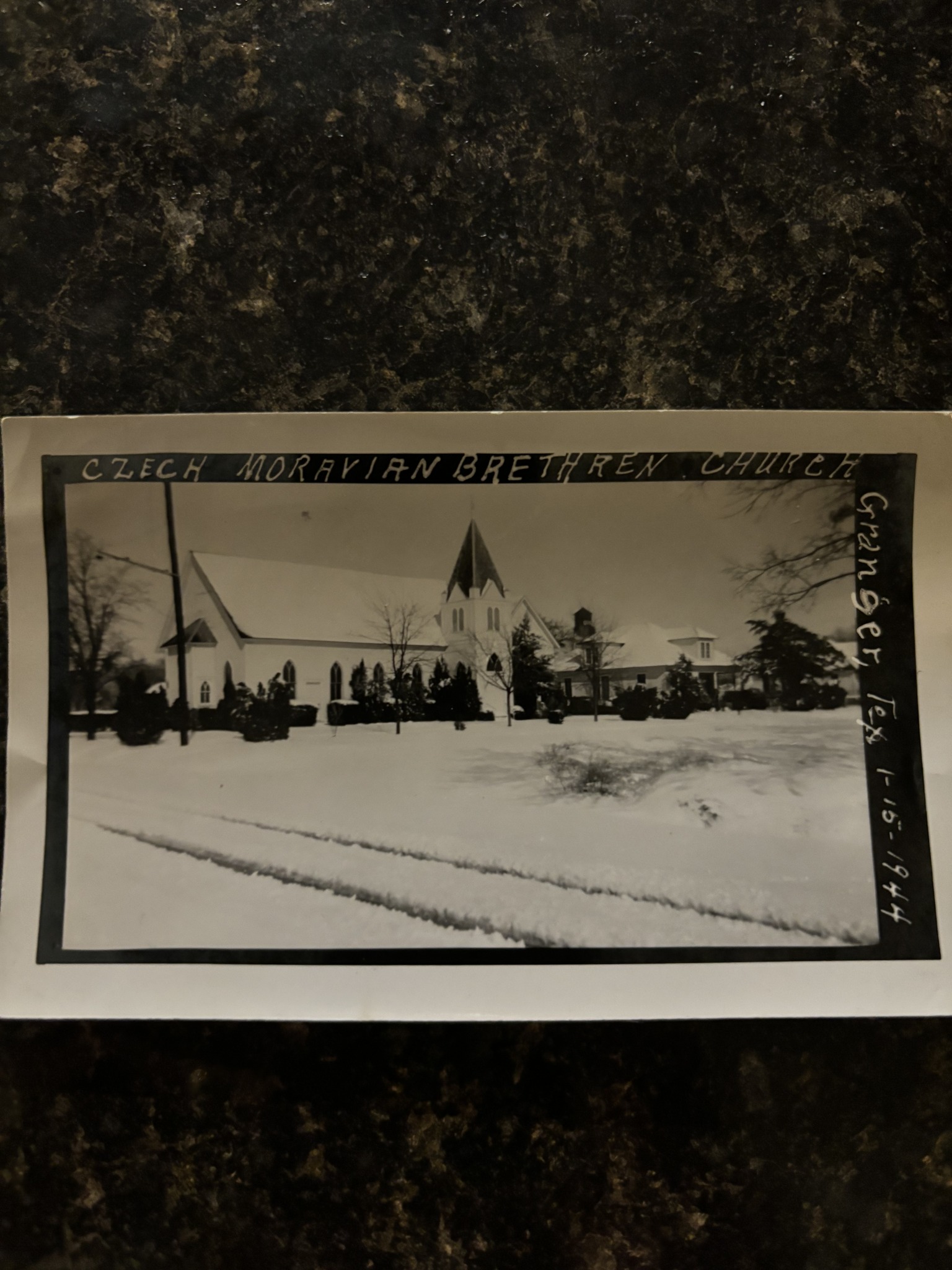
By the mid-1930s the 1901 building needed real work. The congregation chose to remodel rather than rebuild. The bell tower was demolished and rebuilt in eight days of cold, rainy weather between November 29 and December 7, 1937, at a cost of fourteen hundred dollars. The broader remodel continued through 1938 and took close to three hundred days of donated labor. John Marcon of Taylor, Texas drew the plans and served as head carpenter.
The two bells were reinstalled, one for worship and one only for funerals. A proclamation describing the project was written by the building committee in their native Czech and tucked into the structure.
Before the bell tower was closed up, the building committee and Rev. Barton signed a wood plank and sealed it inside, much like the Navy's plank-owner tradition. The plank survives, and you can still read it.
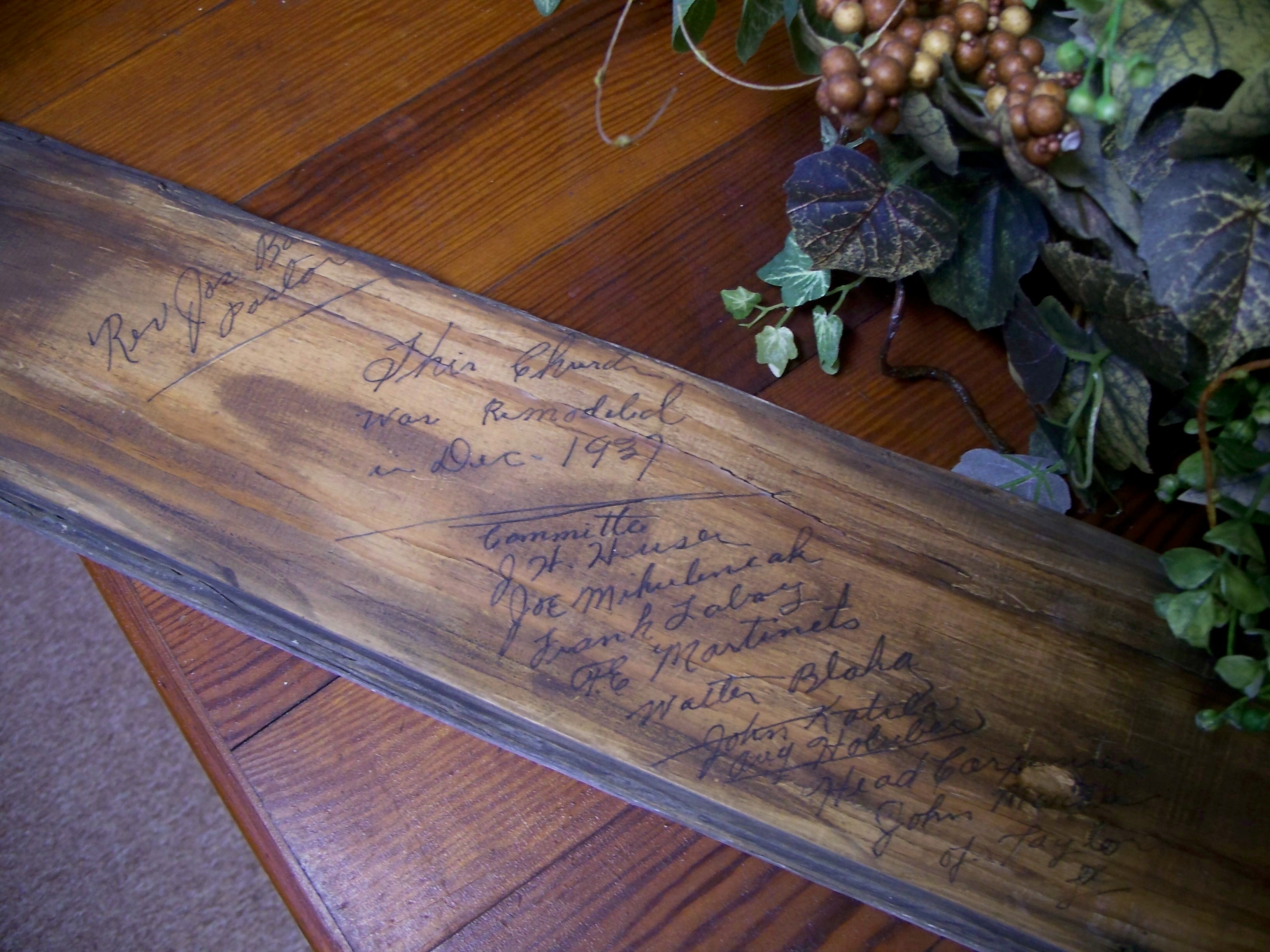
Rev. Jos. Barton · J.H. Huser · Joe Mikulencak · Frank Labaj · F.E. Martinets · Walter Blaha · John Kotrla · Aug. Holubec
Three of the committee (Mikulencak, Labaj, and Holubec) were returning World War I veterans. Mrs. Elsie Barton's 1992 narrative also credits two women on the committee, Mrs. Henry Labaj and Ella Dusek, alongside the plank signers.
The mid-century chapters
1924, Sunday School addition
A Sunday School wing was added to the main church structure, the room visible to the right of the front facade.
1935, the inscription above the sanctuary doors
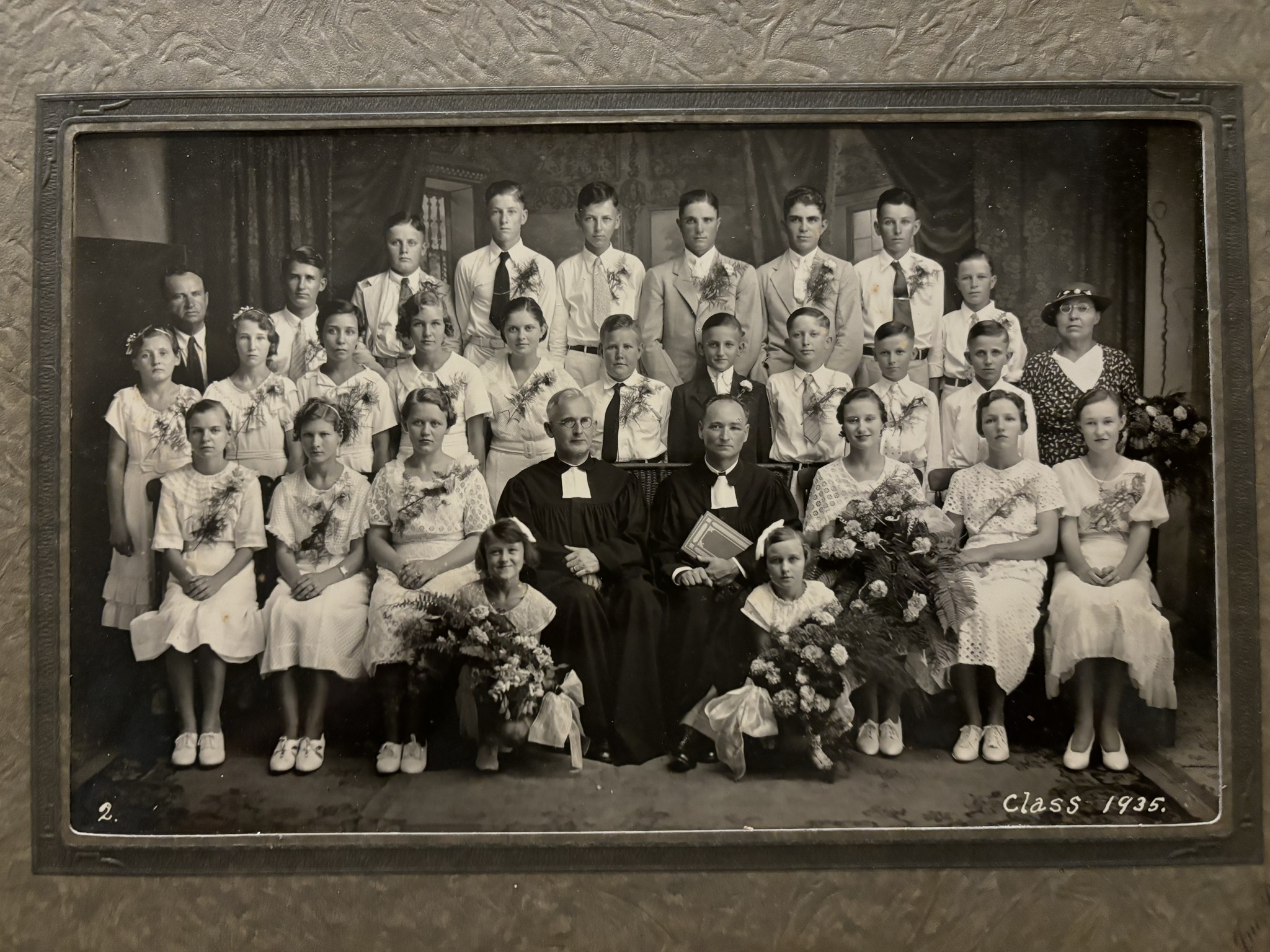
Jerry Martinets painted Joshua 24:15 in Czech ("Já a dům můj sloužiti budeme hospodinu") above the rear sanctuary doors on behalf of his confirmation class. It's still there.
September 22, 1942, Golden Jubilee
The congregation marked its fiftieth anniversary on September 22, 1942, fifty years from the July 1892 founding. The Golden Jubilee fell in the middle of World War II.
August 28, 1945, Rev. Josef Barton, Sr. dies
The first resident pastor, ordained 1910 and serving through the 1937 remodel, is buried in our cemetery.
June 11, 1950, fellowship hall dedicated
A new fellowship hall was dedicated on June 11, 1950. The building was originally a center-cut of a hospital ward, brought from Camp Swift government surplus at Bastrop, Texas.
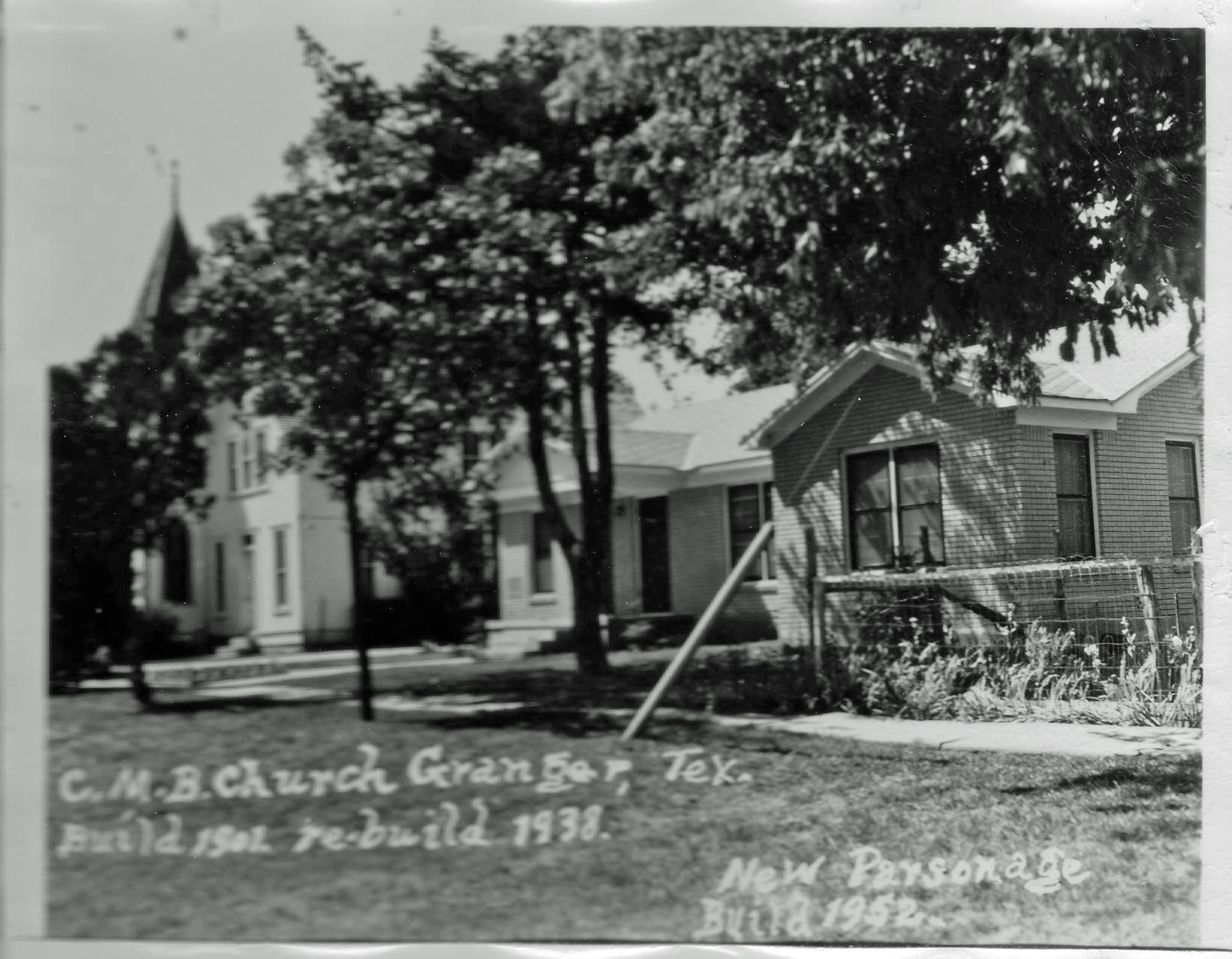
1951, fire destroys the parsonage
Architectural plans for a new one were drawn up in March 1952, and the new parsonage was built shortly after. (Mrs. Elsie Barton's 1992 narrative dates the fire to 1950 and the new parsonage to 1953.)
1953, church rededication
The church was rededicated in 1953.
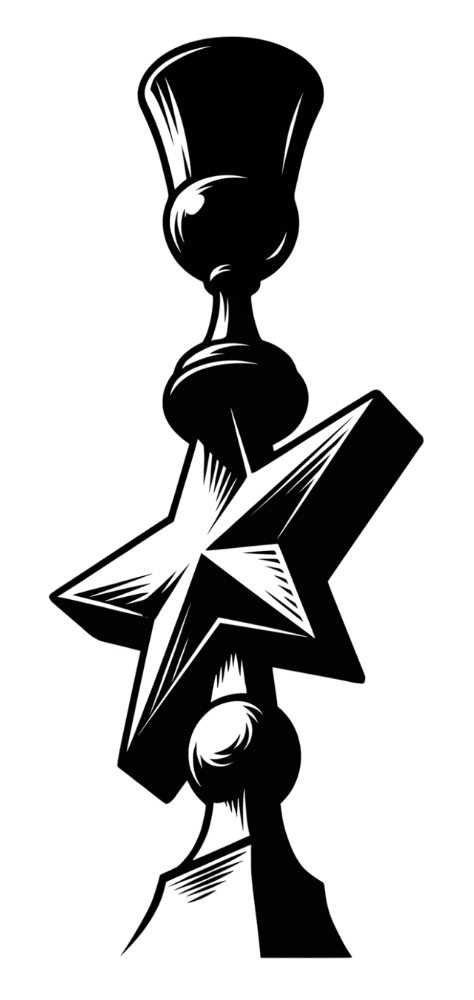
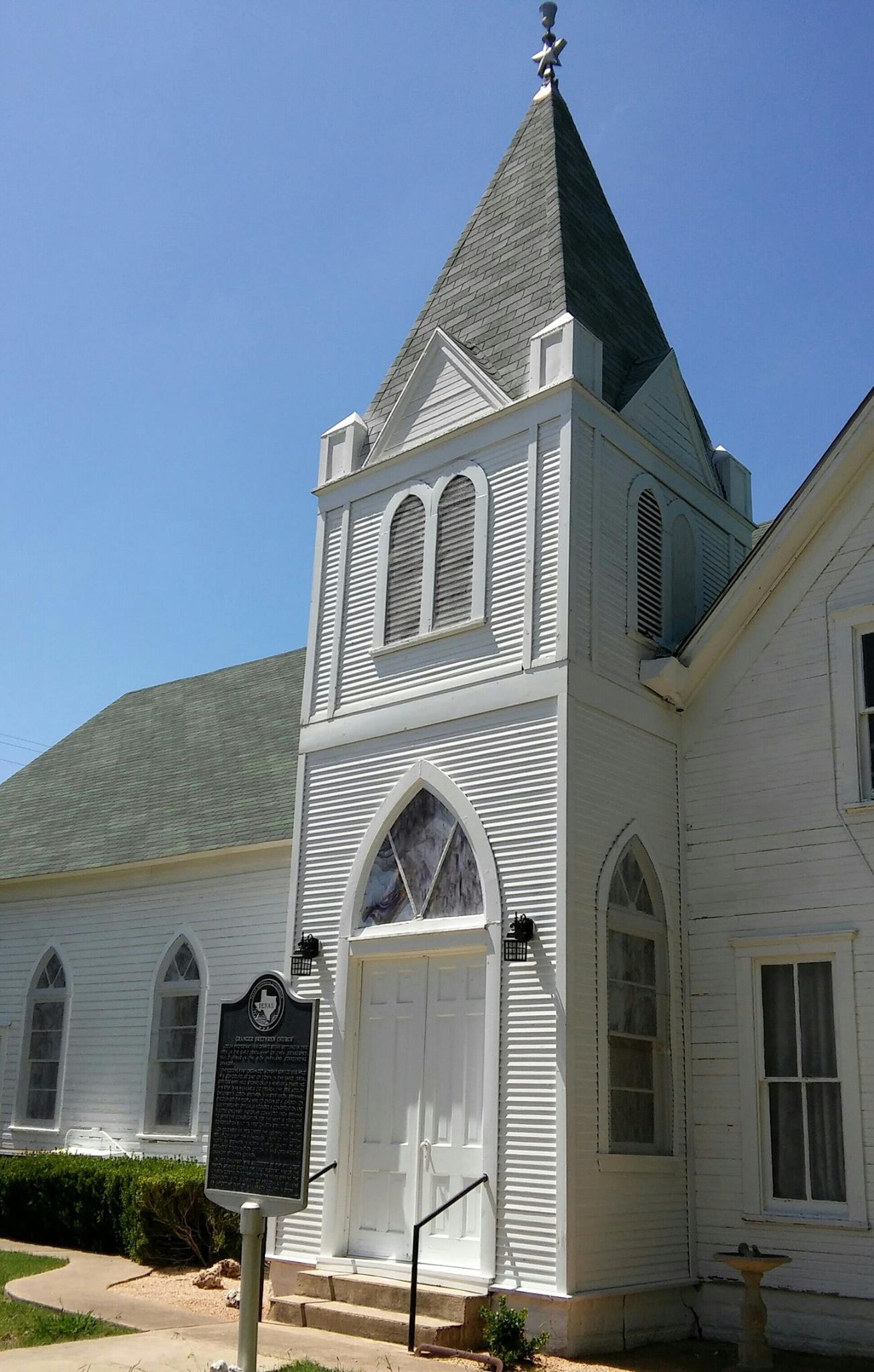
A Texas star and a Hussite chalice
The steeple bears two symbols, side by side.
The Star
The five-pointed star, for the State of Texas. We've called Texas home since the 1880s.
The Chalice
The Hussite kalich, for Jan Hus, the Czech reformer martyred in 1415, and for the conviction that the Lord's Supper belongs to the whole people of God.
The Brethren
Together they say what we are: a Czech Brethren church that has been at home in Texas for more than a century.
In essentials, unity
The Brethren motto sums up what we believe.
Unity
Scripture is our foundation. We confess God as Father, Son, and Holy Spirit, and Christ as the way to salvation. The Lord's Supper and Baptism are sacraments. Christ will come again to judge in mercy.
Liberty
On the things Scripture leaves open (the mechanics of Communion, the mode of Baptism, the shape of church government) we leave one another free.
Love
"If you have love for one another, then everyone will know that you are my disciples." (John 13:35)
The modern chapters
1990, the annex and time capsule
The hallway connecting the church and the fellowship hall was finished by 1990. A time capsule was sealed beneath the cement step into the hall, intended to be opened at the sesquicentennial in 2042.
November 8, 1992, the Centennial
One hundred years from the founding. The Texas Historical Marker was unveiled on the church grounds. The printed program is preserved in our archive.
2009, the archive begins
The translation and archival preservation of the church's Czech-language records began in 2009. Kelly Zrubek did this work on the church's behalf, and it's the reason the archive on this site exists. Every baptism, marriage, confirmation, and funeral record from the founding era was transcribed and rendered in English because of her work.
2015, painting and restoration
A painting and restoration campaign for the building started in 2015.
2016, the bells return
The historic steeple was repaired and the bells restored in 2016, with help from members, the Unity of the Brethren, the community of Granger, and neighboring congregations.
Our pastors
The line of preachers who've served this congregation, drawn from the church's ministers ledger and Mrs. Elsie Barton's 1992 historical narrative.
Traveling ministers
Before the congregation organized, services were held by visiting pastors including the Rev. Henry Juren of Fayetteville and the Rev. Bohumil Lacjak of Wesley.
The Rev. Adolph Chlumsky
First pastor. Commuted from Brenham for eighteen years while serving and organizing other Czech Brethren congregations across Texas. Resigned at 68. Died 1919; buried in our cemetery.
The Rev. Josef Barton, Sr.
Born September 26, 1886 in Hodslavicich, Moravia. Ordained July 6, 1910 in West, Texas; the first student of the denomination. Our first resident pastor; served over 35 years until his death on August 28, 1945. Buried in our cemetery.
The Rev. Joseph Hegar
Succeeded Rev. Barton Sr. after his death.
The Rev. Vaclav Vavrina
Died 1950; buried in our cemetery.
The Rev. Gordon A. Hejl
First tenure beginning 1951; later elected pastor of the Rosenburg Brethren Church. Returned to Granger for a second pastorate in 1983.
The Rev. Frank A. Simcik
Assigned January 1, 1953.
The Rev. Jesse E. Skrivanek
Served until December 31, 1957.
The Rev. Eugene Kotrla
Ordained June 8, 1956. Served January 1, 1958 to January 1, 1960.
The Rev. Albert Michalik
First Granger tenure. Ordained February 5, 1960. Assigned to Seaton Brethren in 1966.
The Rev. Glenn Jurek
The Rev. Josef A. Barton
Son of Rev. Barton, Sr. Died 1979.
The Rev. Daniel J. Marek
The Rev. Henry Beseda
The Rev. Terry Loessin
Native son; great-great-great grandson of Pavel Machu.
The Rev. Gordon A. Hejl, returning
Second pastorate, beginning 1983.
The Rev. Albert Michalik, returning
Returned to Granger as pastor in the 1990s after his Seaton tenure.
The Rev. Judy Gotcher
Our current pastor.
Joseph Hegar · Albert Michalik · John Baletka · Jaroslav Mrazek · F.D. Svoboda · Dr. Frank Luksa · Josef A. Barton · J.F. Kostohryz · Bohumil Jan Dittrich · John H. Johansen · Henry E. Beseda Jr. · Jarkovsky · Dr. E.L. Kautz · Dr. Kovar · Bishop Hoyler · David Marek
The record of pastors between the 1990s and today is still being compiled.
By date
Everything we have, listed in order.
Czech immigrants first settle in Granger
The earliest Czech Protestant farming families arrive in Williamson County.
July 10, congregation organized
Organizing service held at the Moravia School southeast of town. Rev. Adolph Chlumsky elected pastor.
Construction begins
Work begins on the church building.
September 22, dedication
The main church structure is dedicated.
České Školy organized
Czech-language schools organized in Granger.
December 29, Unity of the Brethren organized
22 delegates from 11 congregations meet in Granger and organize the Evangelical Unity of the Czech-Moravian Brethren in North America.
Christian Sisters founded
The Granger Brethren Christian Sisters group is founded. Active for over a century; no longer meeting.
July 6, Rev. Josef Barton ordained
First resident pastor.
Hus School formalized
First class taught in Granger.
July, Thirteenth Congress of the Unity of the Brethren
The denominational congress meets in Granger.
November 17, cemetery land purchased
Two acres east of town purchased from M. Schramm.
June 11, first burial
Frantiska Janyska, the first interment in the New Brethren Cemetery. (Mrs. Elsie Barton's 1992 narrative gives the name as Frantiska; the church's 2015 timeline gives Anton Janyska.)
Rev. Adolph Chlumsky dies
Buried in the cemetery.
Sunday School wing added
An addition to the main structure.
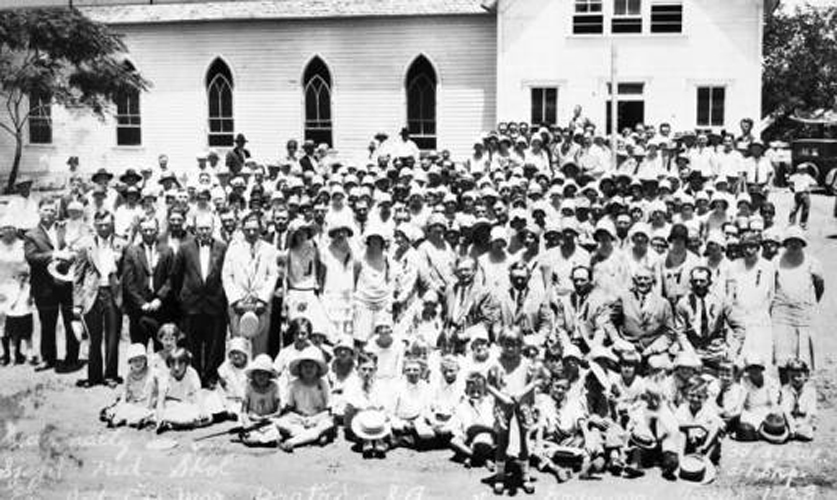
17th Sunday School Convention
Held at Granger Brethren Church.
Sanctuary door inscription
Jerry Martinets paints the Joshua 24:15 inscription over the rear sanctuary doors on behalf of his confirmation class.
December 7, remodel completed; bell tower rebuilt
Eight-day rebuild; bells reinstalled; signed plank sealed inside.
Broader remodel completed
The remodel that began with the December 1937 bell-tower rebuild continued into 1938. About 300 days of donated labor.
September 22, Golden Jubilee
Fifty years from the 1892 founding.
August 28, Rev. Josef Barton, Sr. dies
Buried in the cemetery.
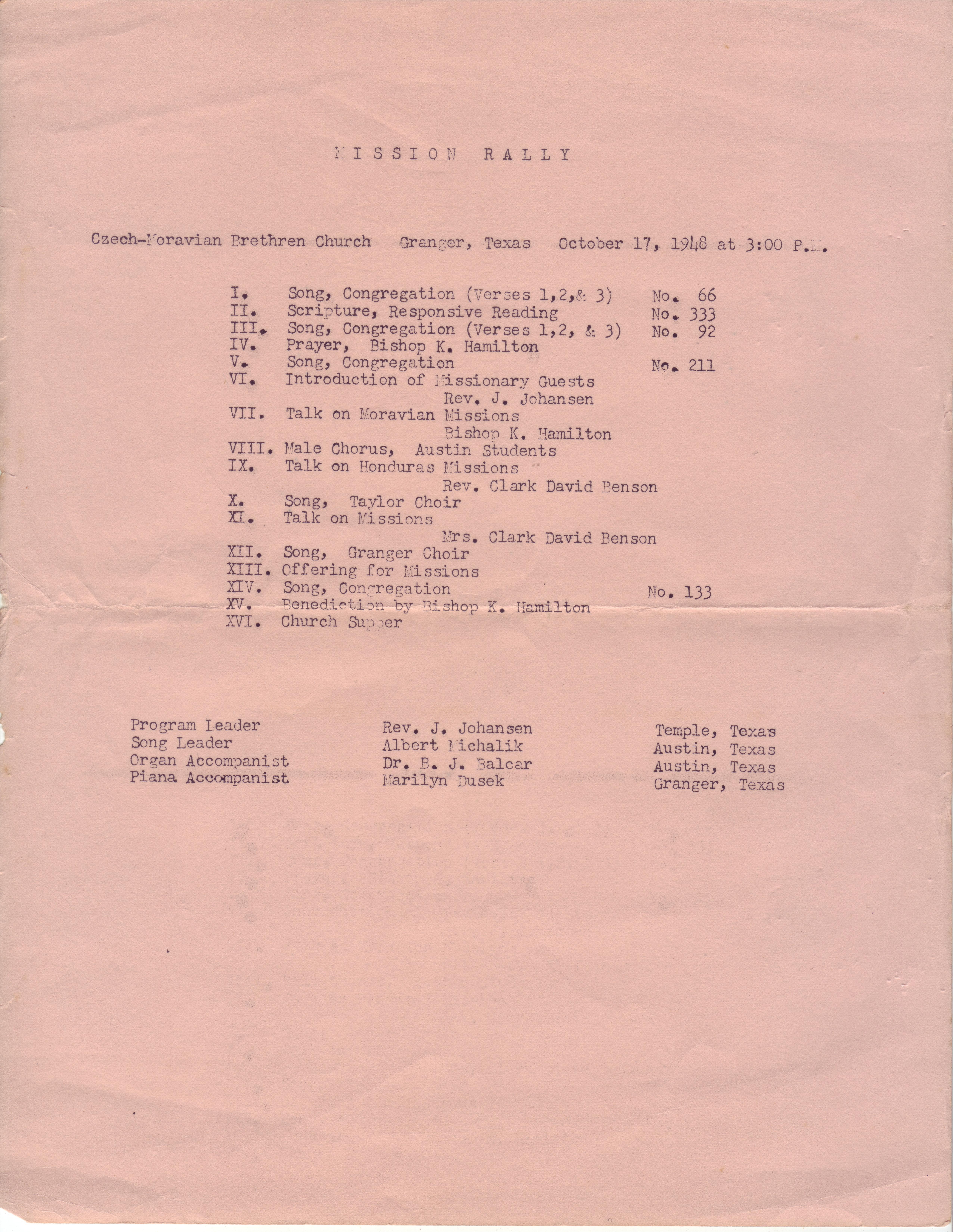
October 17, Mission Rally
A mission rally held at the church, with hymns, talks on Moravian and Honduras missions, and a church supper.
June 11, fellowship hall dedicated
The building was originally a center-cut of a hospital ward brought from Camp Swift government surplus at Bastrop, Texas.
Rev. Vaclav Vavrina dies
Buried in the cemetery.
Fire destroys parsonage
New parsonage built
Architectural plans drawn March 1952; building completed later that year.
Church rededication
Rev. Josef A. Barton dies
Son of Rev. Barton, Sr.
Annex completed; time capsule sealed
The hallway connecting church and fellowship hall is finished. A time capsule is sealed beneath the cement step into the fellowship hall, to be opened at the sesquicentennial in 2042.
November 8, Centennial Celebration
Texas Historical Marker unveiled.
Archive preservation begins
Translation and archival preservation of church records, led by Kelly Zrubek.
Painting and restoration campaign
Steeple repaired; bells restored
A church with roots in Bohemia
and a home in Texas.
The Texas Historical Marker on the front of the church was designated in 1992 for our centennial. It hangs between the red doors.